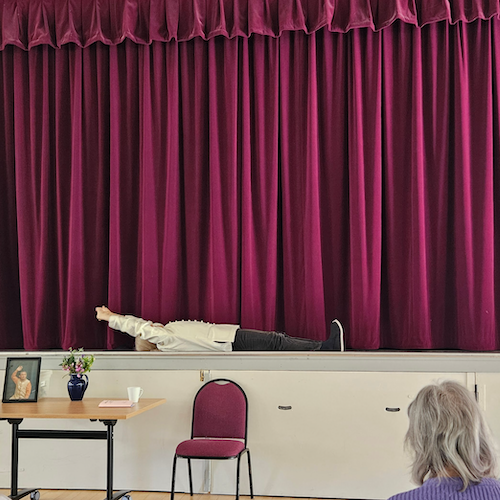
Lying-down exercises are valuable for people who aren’t well and can't stand, as well as those who spend long periods sitting or standing throughout the day. Whether because of limited mobility, the demands of everyday life, or the strain of holding the same posture for too long, everyone can benefit from the chance to lie down, relax, and open up. It's a valuable practice, accessible to people with different needs and mobility levels.
Lying Down practice for people unable to stand
Dr Shen Hongxun intended these exercises to be accessible even to people who are bedbound or unable to stand. They can be done on a bed, although the feedback from the ground is clearer when using a mat on the floor. Comfort and warmth are very important – warm layers and, if needed, a small cushion or folded blanket can be placed under the neck or knees. Even with limited mobility, there are still ways to practise.
Adapting the exercises for different abilities
For older people, or those who have difficulty getting down onto or up from the floor, you can adapt exercises for a chair or practise them with the support of a wall. For example, you can explore Baby Crawling in a seated variation, moving the hands along the floor, or by standing and walking the hands up a wall. These alternatives let people explore the underlying principles of the exercises in ways that suit their abilities. Buqi emphasises working gently and without force, finding a comfortable starting point, and allowing movement and relaxation to develop naturally.
The Double Vicious Circle: posture, tension and energy
A central theme of Dr Shen’s teachings is the Double Vicious Circle: how physical compression, poor posture, and accumulated stress can reinforce one another. Most of us must spend long periods sitting, especially for work.
Over time, our posture collapses or slumps. This compresses our spine and constricts the spaces in between the vertebrae. Tension and emotional stress often contribute to this pattern, making it increasingly hard to relax and open the body.
The exercises taught in the recent Lying Down workshop showed how to interrupt this cycle by giving the body the support of the floor. By reducing the need to hold ourselves upright, we could work with the spine without relying on muscular force.
Opening the spine through movement
Within the Buqi system, the spine is linked to the Central Channel – the main energy channel that allows energy to move through the body. The body needs to be more open and relaxed to release accumulated tension and allow our energy to move freely.
During Lying Down exercises, as the body relaxes and the spine begins to open, emotional responses may arise. In our practice, we allow these responses to unfold naturally rather than force or suppress them. Giving ourselves time and space to relax is an important part of the process.
Emotional release and allowing the body to relax
A major theme in the Buqi system is the relationship between physical tension and emotional stress. Accumulated stress and difficult emotions contribute to the body's sense of heaviness and restriction.
Lying down as an alternative to seated meditation
Many meditation practices involve sitting upright for extended periods. However, prolonged sitting can be challenging for people whose bodies have become stiff, compressed, or uncomfortable. So, Dr Shen’s lying-down exercises offer another way to approach internal practice. With the floor supporting the body, it becomes easier to notice where tension is held and explore relaxation without continually working to maintain a seated posture.